.avif)
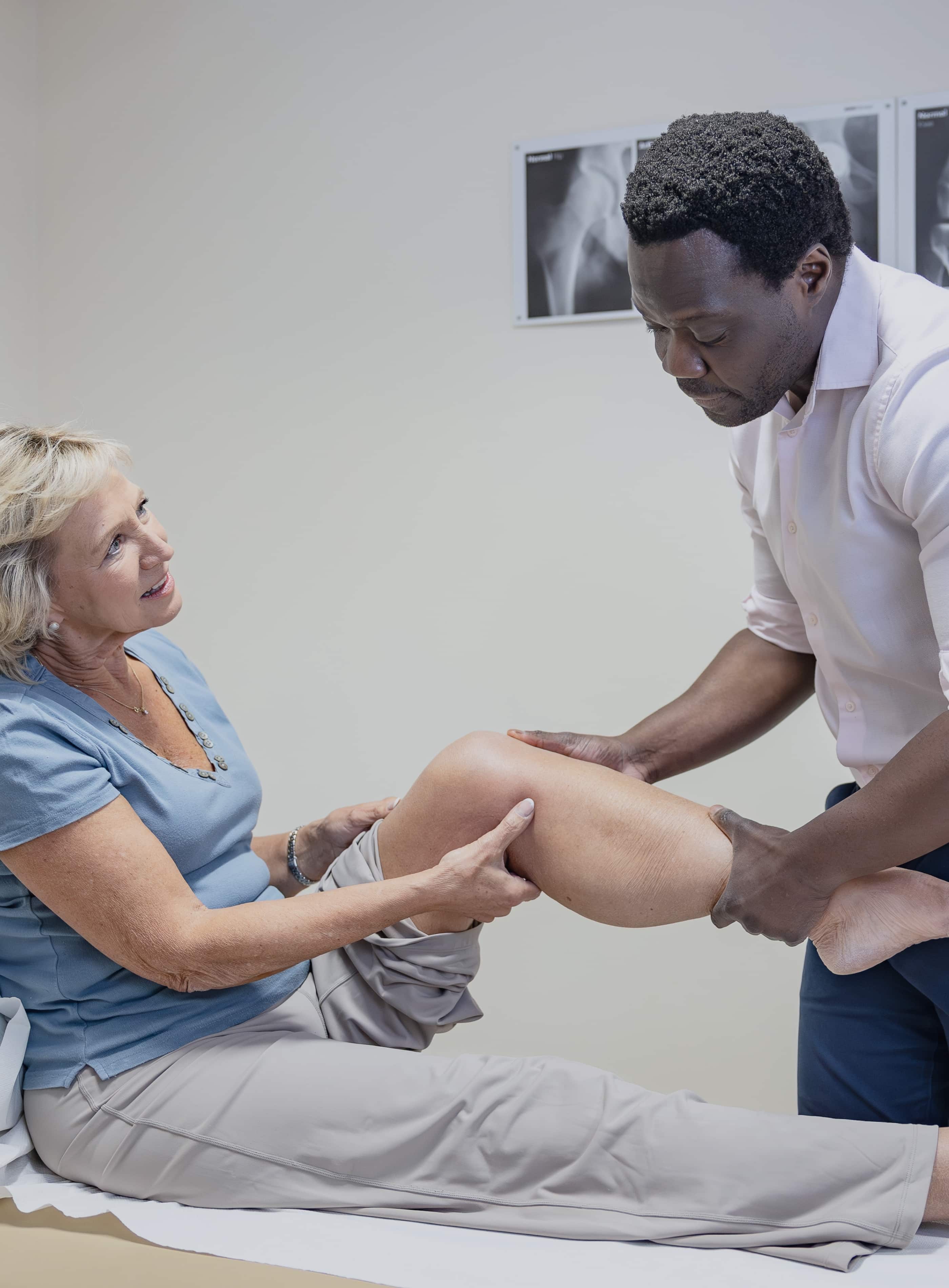
A knee that locks is one of the few orthopaedic symptoms that tells you something quite specific. Most knee pain could be any of a dozen things. Locking narrows it down considerably, which is why I always want to know exactly what a patient means when they use the word.
The trouble is that people use it to describe two different experiences, and only one of them is locking in the sense a surgeon means.
True locking is a mechanical block. Something physical is sitting where it should not be, wedged between the joint surfaces, and the knee will not straighten no matter what you do with it. Often you can bend it further but not extend it. Sometimes it releases with a clunk after a few minutes of wriggling, sometimes it does not release at all.
The usual cause is a torn piece of meniscus that has flipped into the middle of the joint. The pattern surgeons call a bucket handle tear does this classically. The other cause is a loose body, a fragment of cartilage or bone that has broken off and is floating around until it finds somewhere inconvenient to sit.
If your knee genuinely will not straighten, that is not something to sit on for a few months and see how it goes. A meniscus that has displaced can often be repaired if it is dealt with reasonably promptly, and the options narrow as time passes.
Far more common, and frequently mislabelled. The knee feels like it catches or gives way or seizes up, particularly after sitting still for a while, but if you push through it the knee does move.
This is usually pain and swelling doing the work rather than anything being physically stuck. A swollen joint is a tight joint and the muscles around it stop firing properly, so the knee feels unreliable. Arthritis behind the kneecap produces exactly this, which is why so many people describe their knee locking when they stand up from a cinema seat or get out of the car.
It is not trivial and it deserves treating, but it does not usually need a camera in the joint, and this is precisely the distinction that determines whether surgery would help you.
A knee that is stuck in a bent position and will not come out straight is the one to act on. The same goes for a knee that locked after a specific twisting injury, particularly in a younger or sporting patient, because that combination points towards a repairable meniscal tear and repair is time sensitive.
Recurrent catching that settles each time is less urgent but still worth investigating rather than living around.
Most of the diagnosis happens in the consultation. How it started, what position the knee gets stuck in, whether it swells afterwards and whether it releases on its own tell me most of what I need. An MRI scan then confirms what is going on inside the joint and whether the meniscus is torn in a pattern that can be repaired.
Where there is a genuine mechanical block, arthroscopy is one of the clearer indications for surgery in the whole of knee practice. The camera goes in, the displaced fragment is either repaired back into position or trimmed, and the knee straightens again. For suitable patients this can now be done awake under local anaesthetic with a very small camera, which avoids a general anaesthetic and a hospital admission.
Where the locking turns out to be pseudo locking from arthritis, an arthroscopy is the wrong operation and would leave you no better. The treatment there is aimed at the arthritis, which might mean physiotherapy, an injection, or in time a replacement.
Before your appointment, try to work out whether your knee is stuck or whether it is sore and stiff. If you can straighten it when you have to, even if it hurts, that is useful information. If you physically cannot, that is more useful still.
It sounds like a small distinction. It is most of the diagnosis.
This is usually pseudo locking from stiffness and swelling rather than a true mechanical block, and it is very common with arthritis behind the kneecap.
Yes. A knee that locks and unlocks is often a displaced meniscal fragment moving in and out of position, and it tends to recur.
An episode can settle on its own, but the underlying tear or loose body does not disappear.
A meniscal tear that could have been repaired may become untreatable other than by trimming it away, and a knee held in a bent position for a long period becomes stiff.
No. It depends entirely on whether the locking is mechanical. That is what the consultation and scan are for.
There is more on knee locking and on knee arthroscopy elsewhere on this site. If your knee is catching, giving way or will not straighten, you can book a consultation at one of my clinics in Kent and East Sussex.